
Resources
The Truth & Solutions Are Often Found In The Studies & The Data
The Council on Criminal Justice (2023) found that justice-involved veterans were nearly twice as likely to attempt suicide as veterans with no justice involvement.
Veterans Court statistics are essential for evaluation, policy-making, resource management, and advocacy, ultimately contributing their success after the military.
Your Trusted Veteran Associates
Veterans Legal Associates aims to provide a lifelong support system for Veterans who become involved in the criminal justice system.
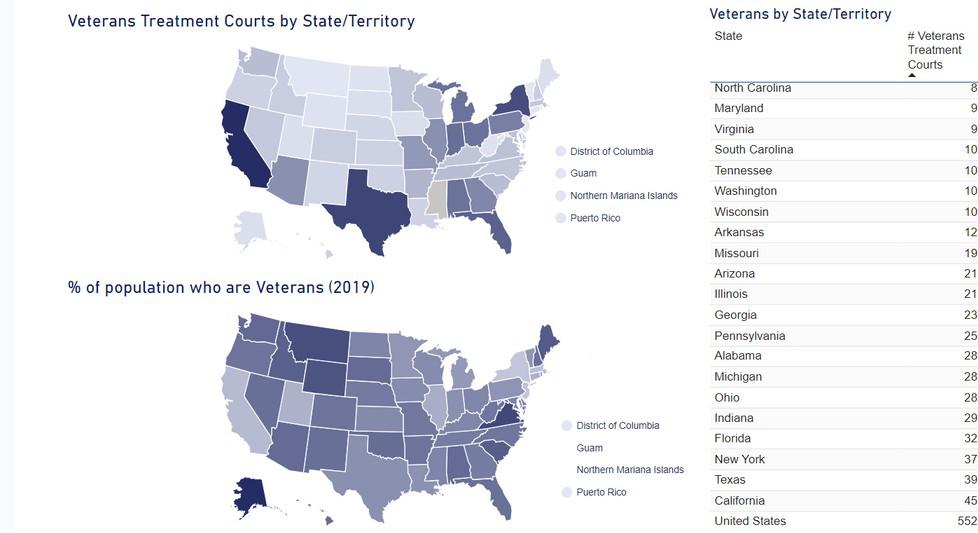
The Coverage Gap: Veterans Treatment Courts vs. Veteran Population
Veterans treatment courts work — but most veterans who need one can’t reach one. That gap is why Veterans Legal Associates is working to expand courts.
The national picture
- As of December 2023, only 15% of U.S. counties had an operational veterans treatment court (VTC), and eight states had none at all.
- VTCs are unavailable in counties where roughly 6.8 million veterans live, and only an estimated 10–15% of justice-involved veterans can access one. (Council on Criminal Justice, Veterans Justice Commission, via NCSL, Oct 2024.)
- Nationwide totals run from 500+ dedicated VTCs (Justice for Vets) to about 750 veterans programs in 49 states (VA-cited, 2026). Counts differ because some sources count veterans tracks inside drug/collaborative courts.
- 85% of U.S. counties lack a VTC. In rural areas, regional multi-county courts are the common fix.
California (~1.24 million veterans)
- About 33 VTCs across 29 counties; a broader count finds 47 veterans dockets. California has 58 counties — roughly half have no dedicated VTC.
- Coverage clusters on the coast and in the big metros. The gaps are the rural far north and the interior/Central Valley, including San Joaquin, Merced, Madera, and Imperial counties.
- California also has statewide military diversion (Penal Code 1001.80) and veteran sentencing law (1170.9) that apply in any court.
Michigan (~435,000 veterans)
- Veterans Legal Associates counts 28 veterans courts statewide. The State Court Administrative Office’s FY2026 list shows courts in about 22 counties, including Wayne, Oakland, Macomb, Genesee, Washtenaw, Kent, Kalamazoo, and Saginaw.
- The gap is geographic: courts sit almost entirely in the southern Lower Peninsula. There is no VTC anywhere in the Upper Peninsula, and none across most of the northern Lower Peninsula — including Grand Traverse County and Crawford County, despite Camp Grayling.
Where courts are needed most
- North Carolina: the 4th-largest veteran population (~621,000) but historically only a handful of VTCs for 100 counties; advocates estimate about 17 are needed.
- The eight states with no VTC at all (Dec 2023).
- Rural counties generally, and mid-size counties in Texas, Georgia, and Pennsylvania, where courts cluster in the biggest metros.
- In-state deserts: northern Michigan and the Upper Peninsula; California’s interior and far north.
- Contrast: Florida (1.31 million veterans) is comparatively saturated with veterans courts.
A note on the numbers
Counts vary by source and year; dedicated-court counts and veterans-track counts are labeled as such above. County-level need data for a grant application — veterans in the local justice system, substance-use and mental-health trends, TBI prevalence, offense types — must come from the applicant county and its VA Veterans Justice Outreach specialist.